Proposed Annual VSB Membership Dues Increase: Frequently Asked Questions

The Virginia State Bar (VSB) is a self-sustaining, non-general fund agency responsible for raising its own revenue, most significantly through its annual membership dues. The VSB receives most of its revenue through annual membership dues payments. The VSB also generates revenue through other sources, such as mandatory continuing legal education (MCLE) course sponsor fees, delinquency fees, section dues allotments, and Virginia Lawyer Referral Service administrative fees and remittances.

Beginning in 1995, VSB annual dues were statutorily capped at $250. On July 1, 2026, HB 276 will become law, and the statutory cap will increase to $350. VSB annual dues for active and associate members, $250 and $125, respectively, have not increased since July 1, 2000.

Part Six, Section IV, Paragraph 11 of the Rules of the Supreme Court of Virginia (Paragraph 11) states the VSB annual dues may not exceed $250 for active members and $125 for associate members.

The VSB plans to update Paragraph 11 in light of the statutory cap increase and is considering the amount that member dues will increase by for the 2027–2028 fiscal year. Members are invited to provide comment on this topic by August 17, 2026. Note: Any change to member dues must be approved by the VSB Council and the Supreme Court of Virginia.

Below is a list of frequently asked questions about this potential increase.

Why must the VSB raise dues?

In short, operating costs have increased significantly, and membership numbers have flattened since the last time dues were raised in 2000. The stagnation in VSB membership numbers has resulted in VSB revenue not keeping pace with its operating expenses, resulting in an unbalanced budget.

Inflationary Increases

The growth in VSB expenditures is primarily due to increases in salaries, technology costs, inflation, and rent.

  • Since 2000, salaries have increased 59.5 percent
  • Technology demands and cybersecurity costs have risen substantially.
  • Since 2000, inflation has risen 87 percent.
  • In the past 10 years, rent has increased 28 percent.

Salaries are the VSB’s most significant operating expense. More than 70 percent of the VSB Fiscal Year (FY) 2026 Budget was allocated to employee salaries and benefits – an increase from 65 percent in FY 2000 and 58 percent in FY 2006. Despite the increase in the proportion of operating expenses attributable to employee salaries and benefits, the VSB has not had a corresponding increase in personnel – the FY 2026 budget included 2 fewer positions than funded in FY 2006.

The data show that General Assembly-authorized salary increases, with the VSB’s primary revenue source capped, are highly correlated with the VSB’s increased expenditures, particularly beginning in FY 2021 where, between FY 2021 and 2025, there were 6 separate raises — adding more than a 20 percent increase in wages1. Chart 1 summarizes the mandated compensation increases, which were well-deserved and earned, alongside each FY’s total operating expenditures and revenue.
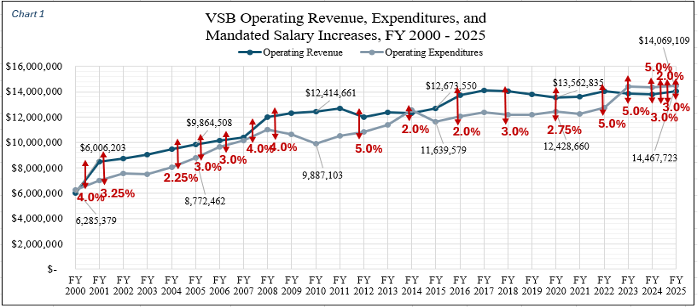
Chart VSB Operating Revenue, Expenses

Flattening Membership Numbers

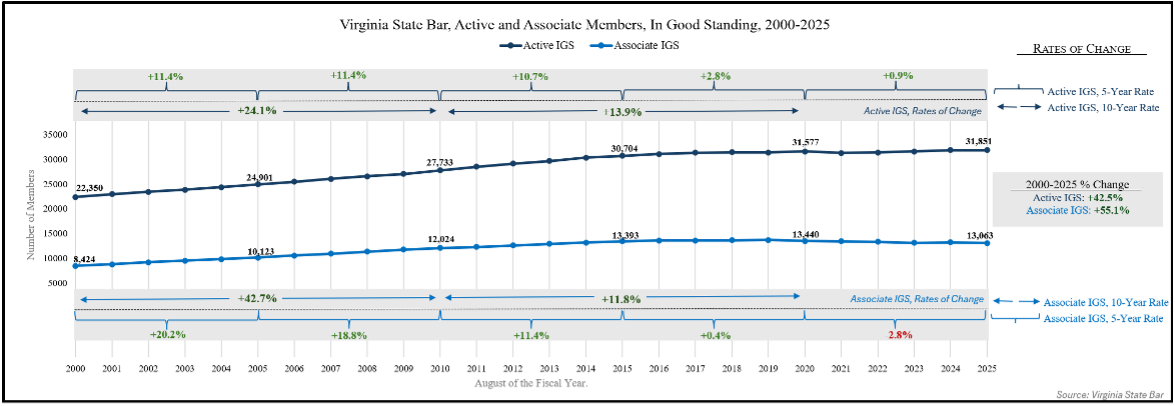
Historically, the number of VSB members generally increased each year, resulting in higher amounts of revenue from annual dues payments—negating the need for a dues increase. However, VSB data show that new VSB admissions are declining (Chart 2) and Active and Associate Membership numbers have flattened (Chart 3).
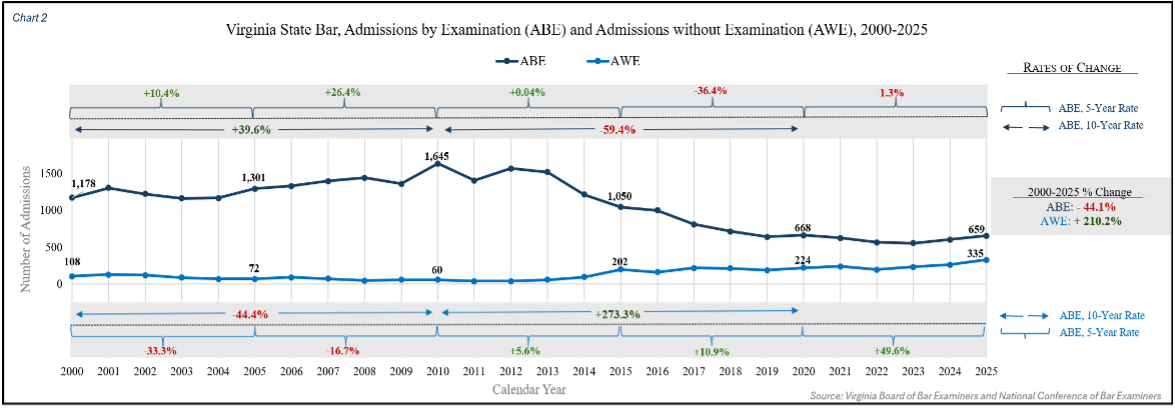
VSB Admissions by Examination ABE

VSB Active and Associate Members

VSB Reserve Fund Depletion

The VSB has used its strategic reserve fund to bridge the gap in the budget. Projections indicate that if member dues are not raised, the VSB will fully deplete its reserve fund by the 2029–2030 fiscal year (Chart 4).
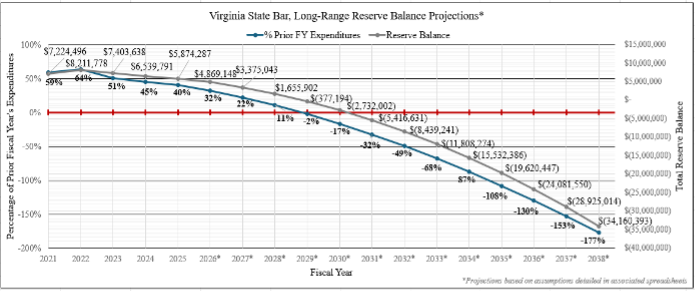
VSB Long-Range Reserve Balance Projections


What would happen if there’s not an increase?

If there is no increase in member dues, the VSB would become insolvent.

What do I get for my annual membership dues?

See The VSB: What We Do-26 for 2026

What has the VSB done to save money or generate non-dues revenue?

The VSB’s 2025–2028 Strategic Plan, adopted by Council in April 2024, has the strategic goal for the VSB to operate from a position of financial health by (i) maximizing revenue generation including, but not limited to, increasing bar dues, pursuing alternative revenue streams, and improving future flexibility of VSB fund balances; (ii) containing expenses; and (iii) educating members on the need for and benefits of VSB financial stability.

The VSB has taken the following steps to try to narrow the gap between its revenue and expenses:

  • Increased MCLE sponsor fees.
  • Restored delinquency fees to pre-pandemic levels.
  • Reduced reliance on print publications and continued review of printing and mailing costs with a focus on leveraging technology for greatest accessibility of resources.
  • Transitioned the four former conferences (Young Lawyers, Senior Lawyers, Diversity, and Local and Specialty Bar Associations) into self-funded sections.
  • For certain events, began charging a fee when attendance was confirmed and the participant had not canceled registration and did not attend.
  • Delayed hiring or did not fill vacant staff positions.

How does Virginia’s attorney licensing fee compare to other states?

VSB member dues rank near the bottom of all mandatory state bar licensing fees and have not been raised in over 25 years. 32 states have mandatory bar associations of those, the VSB is the 4th lowest for reported “Licensing Fees;” however, when you add in the other states’ annual fees for MCLE and their disciplinary systems (including in the VSB licensing fee, the VSB has the lowest annual regulatory fees (tied with West Virginia).

Fee Rankings

Note: the VSB does not have control over the other fees included in the “Cost to Practice.” The $30 Wellness Fee is mandated by the General Assembly and set by the Rules of the Supreme Court of Virginia and the $5 Clients’ Protection Fund fee is authorized by the General Assembly and set by the Rules of the Supreme Court of Virginia. Neither of these fees support VSB operating expenses.

When would a dues increase go into effect?

The VSB plans to implement a dues increase for the 2027–2028 fiscal year, which begins July 1, 2027. Members must pay their dues by the July 31 deadline.

How much will dues increase?

The VSB has proposed raising dues for active members to $300 and associate members to $150. This is a more modest increase from the current fee than the new statutory cap allows. At its October 2026 meeting, VSB Council will vote on the proposal and will submit an agreed upon amount for final approval by the Supreme Court of Virginia.

Chart 5 shows the VSB long-term budget projections with a $50 active member and $25 associate member dues increase, effective for dues payments beginning in June 2027. This increase will allow 2 to 3 years to reassess necessary dues levels for long-term sustainability.

VSB Long-Term Budget Projections

How can I provide input on the proposed increase?

Public comment on the VSB’s proposal is available June 15 through August 17, 2026, on the VSB website.

Additional information

See the 2025–2028 VSB Strategic Plan and Strategic Plan Progress Report (as of June 4, 2026)

See Proposed VSB Dues Increase Overview report presented to the VSB Budget & Finance Committee, June 3, 2026

See the flyer, Ensuring the VSB’s Financial Solvency


1The General Assembly mandated (i) a 5.0 percent raise in June 2021, (ii) a 5.0 percent raise in July 2022, (iii) a 5.0 percent raise in June 2023, (iv) a 2.0 percent raise in December 2023, (v) a 3.0 percent raise in June 2024, and (vi) a 3.0 percent raise in June 2025. As the raised were implemented incrementally over time, each successive increase compounded on the employee’s previously adjusted salary, resulting in a cumulative effect greater than the sum of the individual percentage increases. As of June 15, 2026, whether state employees will receive raises in the 2026-2028 Biennium Budget is yet to be determined.